Treatment in adrenoleukodystrophy differs completely by phenotype. It is worth holding that in mind before reading further: what applies to cerebral disease does not apply to adrenomyeloneuropathy, and the reverse is equally true.
Where things stand
- In cerebral disease, early haematopoietic stem cell transplantation is the only established treatment. Miss the window and it cannot be undone.
- Leriglitazone is becoming an option, though the approved population is narrow.
- Gene therapy is a genuine option with clear limitations.
- Beyond these, there is no established drug.
- Lorenzo’s oil has a limited role.
- Diet is not a disease-modifying treatment but matters for growth and quality of life.
1. Treatment differs by phenotype
| Phenotype | Core treatment | What matters most now |
|---|---|---|
| Cerebral ALD | Early haematopoietic stem cell transplantation | Timing. Catching it early on MRI surveillance |
| Adrenomyeloneuropathy | No established drug. Symptom management and rehabilitation | Slow progression. Watching for cerebral conversion |
| Adrenal insufficiency | Hormone replacement | Missing it is dangerous. Regular testing |
One person may have more than one. Adrenal insufficiency commonly accompanies AMN, and AMN can convert to cerebral disease.
2. Haematopoietic stem cell transplantation
Why “early” is the whole point
Allogeneic haematopoietic cell transplantation can halt progression of cerebral disease. It cannot reverse damage already done. Timing therefore determines almost everything.
The international recommendations state plainly that outcome is poor in advanced disease. Extent of white matter involvement and neurological function are assessed together to judge that.
Transplantation carries real risk. But that risk means something different when set against the natural history of untreated cerebral disease, which progresses rapidly.
Who is eligible
The 2022 international consensus recommendations weigh three things together.
Boys
- Demyelinating lesions with gadolinium enhancement on brain MRI — indicating active disease
- Limited extent of white matter involvement
- Preserved neurological function — no or minimal symptoms
Adult men
- Demyelinating lesions with gadolinium enhancement
- No or few neurocognitive impairments
Extent and function are each scored on established scales, but those scores do not by themselves decide the matter. The recommendations state explicitly that the criteria are not exclusive: falling slightly outside them does not rule a patient out, and meeting them does not make transplantation automatic.
In adult men, severe spinal cord involvement and bilateral internal capsule involvement have been associated with poorer survival.
Eligibility should be determined by a clinician experienced in transplantation for ALD (recommendation 15). In advanced disease, or in progressive lesions without enhancement, transplantation is considered only after careful evaluation at an experienced centre.
Finding cerebral disease early
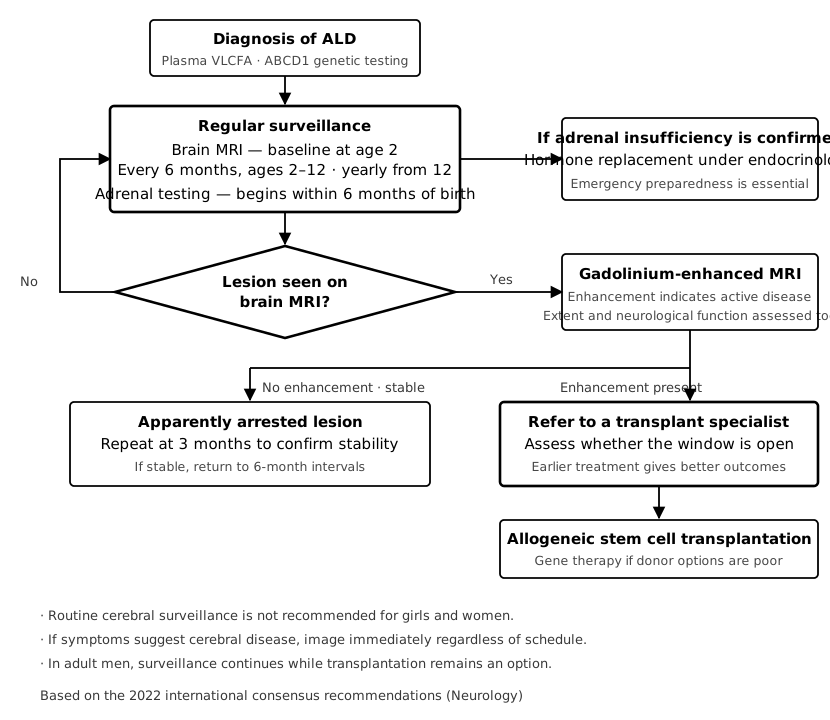
There is no way to do this other than periodic brain MRI in the absence of symptoms.
- All boys and men are screened for cerebral disease regardless of symptoms
- A baseline MRI at age 2 — earlier scans are difficult to interpret because myelination is incomplete
- Every 6 months from 2 to 12 years, then annually
- Routine cerebral surveillance is not recommended for girls and women
- If symptoms suggestive of cerebral disease appear, imaging is done immediately, regardless of schedule
This surveillance is the only mechanism that keeps the transplant window from being missed.
What transplantation does not do
Transplantation is unlikely to affect myeloneuropathy or adrenal insufficiency, as stated in the international recommendations. It halts cerebral disease; it does not cure ALD.
Adrenal function testing and neurological follow-up continue after transplantation.
3. Leriglitazone
Leriglitazone (NEZGLYAL) is a brain-penetrant selective PPARγ agonist — the first oral drug in ALD to reach regulatory approval.
Current status (August 2026)
On 23 July 2026 the CHMP of the European Medicines Agency issued a positive opinion. A decision by the European Commission is expected by the end of September 2026.
Recommended indication
| Age and sex | Boys aged 2–12 |
| Phenotype | Cerebral ALD |
| Brain MRI | Non-gadolinium-enhancing lesions |
| Neurological function | Preserved |
In other words, early disease in which active inflammation is not yet evident and function is retained.
What “approval under exceptional circumstances” means
This route is used where comprehensive data cannot be obtained by conventional means. In a disease this rare, large trials are not feasible. Approval is granted on the condition that data continue to be collected and reported after authorisation.
The evidence
- NEXUS (phase 2/3) — paediatric patients with cerebral disease were clinically and radiologically stable after more than 96 weeks of treatment, or up to a visit prior to transplantation
- Real-world data from compassionate use programmes
- More than 170 patients with cerebral disease treated to date
Development and supply
Leriglitazone was developed by Minoryx Therapeutics (Spain). Neuraxpharm holds the exclusive European licence and will supply it after approval.
Does it apply to adults with AMN
Not at present. In ADVANCE — a 96-week randomised, double-blind, placebo-controlled phase 2–3 trial in adult men with AMN (Lancet Neurology, 2023) — the primary endpoint of six-minute walk distance at week 96 was not met.
Secondary observations included clinically relevant differences in body sway, favourable trends in EDSS, SSPROM and quality of life, and — notably — cerebral disease occurring only in the placebo group.
A separate phase 3 trial, CALYX, is running in adults with cerebral disease.
Availability in Korea is a separate question and has not been decided.
4. Gene therapy
The patient’s own haematopoietic stem cells are collected, a functional ABCD1 gene is inserted, and the cells are returned. No donor is required and there is no risk of graft-versus-host disease.
Skysona — the only approved gene therapy in ALD
The compound is elivaldogene autotemcel (eli-cel), developed by bluebird bio.
| US FDA | Accelerated approval, 16 September 2022 |
| Indication | Boys aged 4–17 with early, active cerebral ALD for whom a matched donor is not available |
| Purpose | To slow progression of neurological dysfunction |
| Europe | Approved July 2021; authorisation withdrawn in November 2021 at the company’s request, for commercial reasons |
| Korea | Not approved |
The indication itself makes the position clear: where allogeneic transplantation is possible, that comes first. This is an option for patients without a donor.
It does not apply to adult men with cerebral disease
Because the licence covers boys aged 4–17, gene therapy is not a treatment option for men with cerebral ALD.
A man with AMN who converts to cerebral disease may be eligible for allogeneic transplantation, depending on a number of factors. Since timing decides the outcome, this is a conversation to have with the treating team without delay. Separately, the CALYX trial of leriglitazone is running in adult men with cerebral ALD. → Clinical Trials
Where the international recommendations place it
Gene therapy should be considered (if available) in boys if allogeneic donor options are poor (recommendation 17)
Even in 2022, the recommendations noted that long-term safety data were not yet available.
The limitation, in numbers
Safety data have changed substantially since approval.
- At approval in 2022: myelodysplastic syndrome in 3 of 67 patients (4%)
- As of July 2025: haematologic malignancy in 10 of 67 patients
- Time to diagnosis: 14 months to 10 years
- All 10 had predominant integrations; 7 in proto-oncogenes, 6 of them in MECOM
- 9 of the 10 were treated with allogeneic transplantation, with or without chemotherapy; one death related to that treatment was reported
The US FDA issued a safety communication in November 2024 and subsequently required labelling changes, advising that allogeneic transplantation be considered first for patients with a suitable donor.
This is not a problem with gene therapy as such
The problem arises from insertional mutagenesis — the lentiviral vector integrating semi-randomly into the genome. It is a property of that platform, not of gene correction in general.
Approaches that correct the gene in the body without inserting a vector — base editing, for instance — do not carry the same risk structure. In ALD, however, these are not yet at a stage where they can be used in people.
5. Lorenzo’s oil
The best-known name in ALD, and the one where expectation and evidence diverge most.
The 2022 international consensus recommendations state:
Data to support the efficacy of Lorenzo’s oil as a disease modifying treatment in ALD patients is insufficient (recommendation 36)
The accompanying text explains why. Lorenzo’s oil (oleic acid C18:1 and erucic acid C22:1) combined with a low-fat diet reduces plasma C26:0 to near-normal values in the majority of patients. But controlled trials showing improved outcome are lacking.
A number improving and a disease improving are not the same thing.
It is still prescribed in practice, to asymptomatic boys and to patients with AMN. Whether to take it is a decision for the patient and their clinicians. Taking it is not a reason to relax cerebral surveillance.
6. Diet
Diet does not halt the disease. It matters for growth, nutritional status and quality of life.
In brief:
- Reducing dietary intake of saturated very long chain fatty acids alone cannot lower body VLCFA levels, because the body also synthesises them
- A moderate restriction of foods high in saturated fat is therefore preferred to a strict low-fat regimen
- Normal growth and appropriate weight come first
- Swallowing difficulty requires separate dietary adaptation
→ Set out in full on the Diet page.
7. Symptom management
In AMN, where no disease-modifying drug exists, symptom management is the treatment. It is not the same as having nothing to offer.
Pain and spasticity — the international recommendations suggest pregabalin or gabapentin for pain and spasmolytics such as baclofen for spasticity, with the aim of maintaining function and quality of life.
Rehabilitation, continence and pain services — referral may be considered alongside routine neurological care.
Adrenal insufficiency — boys and men are screened from within the first six months of life, lifelong. Girls and women are not included. → Adrenal Insufficiency
Head injury — severe head trauma has been reported as a possible trigger for cerebral disease. The causal relationship is not established, but the recommendations advise counselling male patients so that they can make informed choices.
Follow-up — yearly follow-up is recommended for men and women with myeloneuropathy.
8. Finding clinical trials
- ClinicalTrials.gov — search
adrenoleukodystrophy - → Clinical Trials
Please discuss participation with your treating clinicians first.
Sources
Dietary content is based on the following.
Dietary Management in Adrenoleukodystrophy
Dietary content researched and written by Eunju Lee, dietitian With the support of Songmi Lee and Jinsu Kim, Nutrition Team, Severance Hospital Reviewed with preface by Hoon-Chul Kang, MD, PhD, Division of Pediatric Neurology, Severance Children’s Hospital, Yonsei University College of Medicine
The first dietary and cooking guide for patients with adrenoleukodystrophy published in Korea.
Statements about the evidence for Lorenzo’s oil follow the 2022 international consensus recommendations (Neurology, recommendation 36).
Last reviewed: 10 August 2026
This page provides general medical information and does not replace care for an individual patient. Treatment decisions should be made with your treating clinicians.