
This page exists to answer two questions.
“Why is one brother fine while the other has cerebral disease?” “Why is this still so hard to treat?”
The answers meet in the same place: because there is a great deal we still do not know. What follows separates what is established from what is not.
1. What is broken — the minimum
ALD is caused by a defect in ABCD1, a gene on the X chromosome.
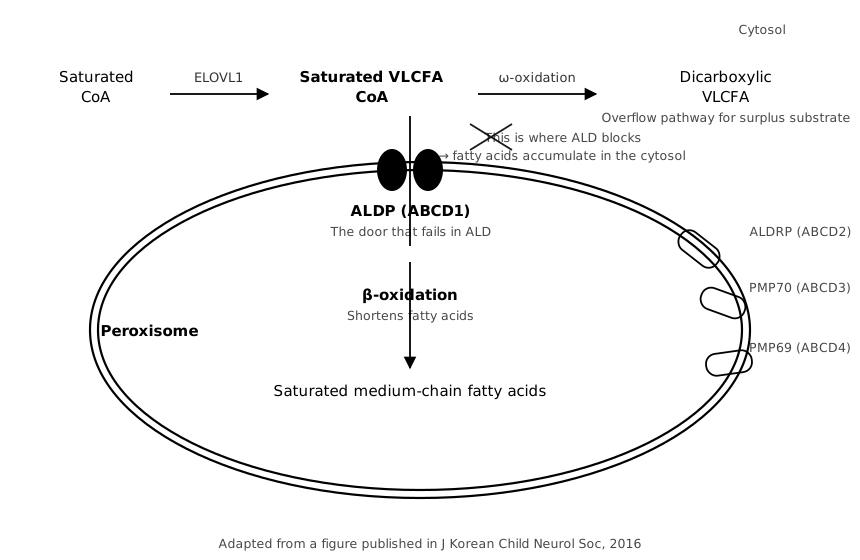
The gene encodes a transport protein (ALDP) sitting in the membrane of the peroxisome, the organelle that breaks down very long fatty acids. ALDP is the door through which those fatty acids enter.
When the door fails, the fatty acids cannot get in and are not broken down. Saturated very long chain fatty acids — C26:0 in particular — accumulate throughout the body.
That is where ALD begins. The plasma VLCFA test used in diagnosis measures exactly this accumulation.
That much is settled. What follows is not.
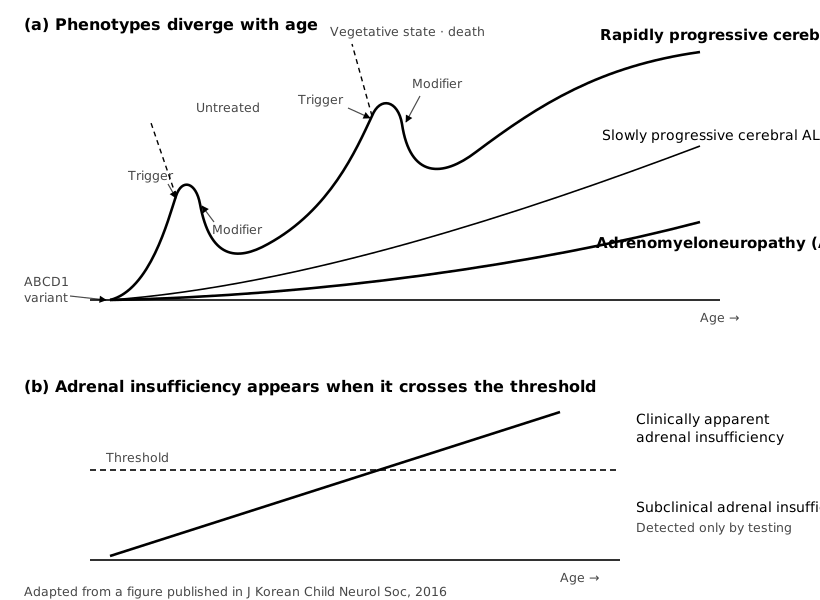
Accumulation alone does not explain why one person’s brain deteriorates rapidly in childhood, another begins to walk poorly in their forties, and a third has almost no symptoms in a lifetime.
2. Knowing the genotype does not predict the course
The question families ask most often, and the hardest to answer.
No consistent relationship has been established between the type of ABCD1 variant and the form the disease takes. There is no rule by which one variant produces cerebral disease and another stops at AMN.
This is not simply a matter of insufficient study. There is direct evidence.
Brothers within the same family, carrying exactly the same variant, develop different phenotypes. Monozygotic twins — genetically identical — have been reported with divergent courses.
Identical twins share their genetic information. That one may progress to cerebral disease while the other does not means something outside the genome determines the outcome.
So it is not possible to look at a genetic test result and say that a child will, or will not, develop cerebral disease. No one can. Any source offering that prediction is worth checking carefully.
Cruel as it sounds, this has a practical consequence. It is precisely why periodic brain MRI surveillance is necessary. Because the course cannot be predicted, it has to be watched — and watching means the window is not missed.
If you have had genetic testing You can look your variant up in the ABCD1 Variant Registry, which collects ABCD1 variants reported worldwide and is free and public. It is particularly helpful where a variant of uncertain significance (VUS) has been reported. As the registry itself states, however, the variant does not predict the course in an individual patient. → References and Links
3. Why some develop cerebral disease — this is not known
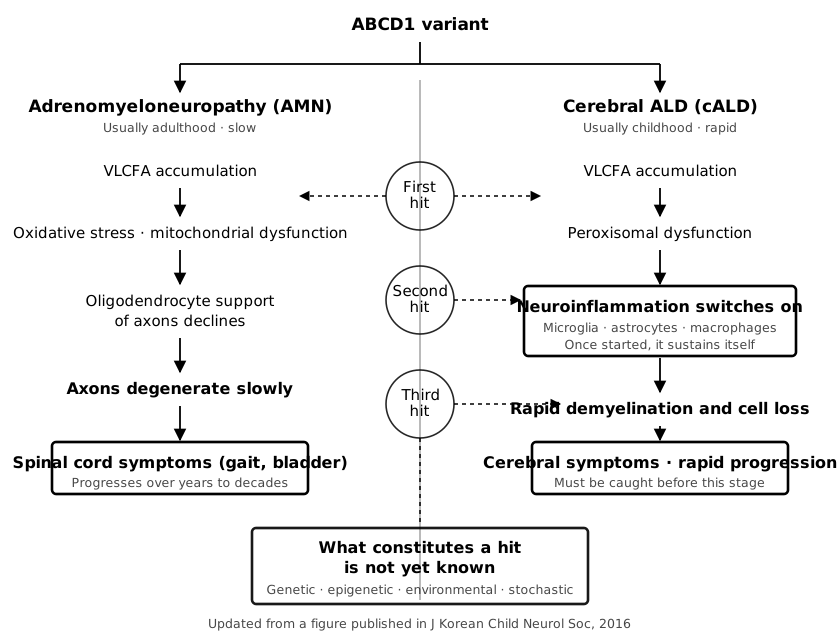
Plainly: the trigger for cerebral conversion has not been identified.
The factors currently thought to be involved:
Modifier genes — genes other than ABCD1 that alter the course. Several candidates have been studied; none is established.
Epigenetic differences — the same DNA sequence, but different patterns of which genes are switched on in which cells.
Environmental factors — infection and trauma are discussed.
Chance — stochastic elements in the interaction between several cell types. It is difficult to explain the divergence between identical twins without it.
One further point. Cerebral lesions have been reported to arrest spontaneously. A progressing lesion may stop; an arrested one may reactivate. A single scan therefore supports neither reassurance nor despair, and following the trajectory is what matters.
So “why us” has no answer
If you encounter a plausible-sounding explanation for why your child in particular, treat it with caution. Nothing a parent did, fed or missed caused this. It is an area where medicine does not have the answer.
4. Head injury — what is known and what is not
Severe head trauma has been reported as a possible trigger for cerebral disease.
The causal relationship is not established. The evidence is at the level of case reports, and it is difficult to separate cause from coincidence of timing.
Even so, the 2022 international consensus recommendations advise counselling male patients about the possibility — not because the evidence is firm, but because knowing allows a person to make their own decisions about how they live.
What to do and not do is for each person to decide. Having had a head injury does not mean cerebral disease will follow, and there is nothing to reproach yourself for in what has already happened.
5. How understanding has shifted over the past decade
Injury in ALD was formerly explained largely in terms of oxidative stress — accumulated VLCFA damaging cells oxidatively. That account still holds, but the centre of gravity has moved.
Towards immune cells. The brain contains resident immune cells, the microglia. Recent work shows that when peroxisomal function fails in microglia, the cells shift into a disease-associated state. The rapid demyelination and inflammation seen in cerebral disease involve microglia, astrocytes and macrophages activating together. Cerebral ALD is therefore less a slow accumulation of fatty acid damage than an inflammatory reaction that switches on at some point.
Towards mitochondria. Work has reported an imbalance in mitochondrial dynamics — the fission and fusion that maintain the organelles.
The role of oligodendrocytes. These cells, which wrap nerve fibres in myelin, turn out to supply energy substrates to axons rather than acting only as insulation. That has changed how axonal injury is understood.
Iron accumulation in the brain has more recently been reported in cerebral disease.
None of this has yet changed clinical practice. But it is changing what should be targeted.
6. Why this understanding has not become treatment
The previous sections answer this question.
First, lowering VLCFA is not sufficient. Lorenzo’s oil does bring plasma VLCFA close to normal. The course of the disease is unchanged. Reducing the causative substance and stopping the injury already under way are different problems.
Second, the inflammation in cerebral disease sustains itself once started. This is why early transplantation works. The graft-derived immune cells are understood to enter the brain and interrupt that process — and for the same reason, it does not work once the disease is advanced. Putting out a fire before it takes hold is not the same as pouring water on the ashes.
Third, the brain is difficult to reach. The blood–brain barrier keeps most drugs out. Part of the interest in leriglitazone was that it penetrates the brain.
Fourth, spinal cord injury in AMN is a different problem. If cerebral disease is inflammatory destruction, the spinal cord lesion of AMN is closer to slow axonal degeneration over years. Treatments that work for cerebral disease therefore do not transfer. It is also why transplantation does not affect myeloneuropathy.
7. Women
ABCD1 is on the X chromosome. Women have two, so it was long assumed that one working copy meant no disease.
That is not so.
Each cell activates only one X at random, so cells in which the faulty copy is active are distributed throughout the body. A substantial proportion of women therefore develop spinal cord symptoms with age.
What matters is the form it takes. In women the problem is myelopathy, in the AMN pattern, and cerebral disease essentially does not occur. International recommendations therefore do not advise routine cerebral surveillance in girls and women.
The 2022 recommendations accordingly advise classifying women with an ABCD1 variant as “asymptomatic/presymptomatic” or “symptomatic women with ALD”, and refraining from the terms heterozygote or carrier.
This is not about wording. Being called a carrier removes a person from clinical care and follow-up.
→ Set out in full on Women with ALD.
What remains unknown
- What triggers conversion to cerebral disease
- Why people with the same variant follow different courses
- Why cerebral lesions sometimes arrest on their own
- Precisely what links VLCFA accumulation to the injury itself
Treatment arrives as that list gets shorter. It is why patient registries and research participation matter.
Based on the 2022 international consensus recommendations (Neurology) and published research. Sources are indicated in the text.
Last reviewed: 7 August 2026
This page provides general medical information and does not replace care for an individual patient.