Cerebral ALD (cALD) is the most rapid and most dangerous form of the disease. Inflammation in the cerebral white matter destroys myelin quickly.
It is also the only form of ALD in which time decides the outcome. Found early, progression can be halted. Found late, there is no way back.
What it is
If adrenomyeloneuropathy is a slow degeneration of spinal cord axons over years, cerebral ALD is an inflammatory reaction that switches on at some point.
Microglia, astrocytes and macrophages activate together, myelin is destroyed, and once it starts it sustains itself. Progression is measured in months, not years.
→ The mechanism is set out in more detail on About ALD.
Who develops it
Mainly boys in childhood. It is rare before age 3 and most common between 4 and 10 years.
In numbers: about 35% of boys with ALD develop cerebral disease in childhood, and across a lifetime the risk for males is estimated at around 60%. Of childhood cases, 85–90% go on to inflammatory demyelination; the remainder include the arrested cases described below.
It is not confined to children. Adult men can develop cerebral disease, and men with AMN can convert to it. Adults therefore need continued surveillance.
It essentially does not occur in females. Girls and women are not subject to routine cerebral surveillance. → Women with ALD
Symptoms
Early symptoms rarely look neurological. That is why diagnosis is delayed.
First signs
- A sudden fall in school performance
- Loss of attention; difficulty following instructions
- Deteriorating handwriting, or difficulty reading
- Behavioural change — withdrawal, or the opposite
At this stage children are not uncommonly diagnosed with ADHD or a learning disorder.
As it progresses
- Visual field loss, difficulty seeing
- Difficulty hearing, or understanding speech
- Unsteady gait
- Difficulty swallowing
- Seizures
Later
- Loss of vision and hearing
- Loss of movement
- An unresponsive state
Untreated, cerebral ALD leads to severe disability or death within a few years of symptom onset.
If there is ALD in the family and a child’s learning or behaviour changes abruptly, saying so at the consultation changes the diagnostic pathway substantially.
It has to be found before symptoms
This is the most important part of this page.
By the time symptoms appear, the lesion is already extensive. Symptoms cannot be the trigger for action. The disease has to be found on brain MRI while the child is still well.
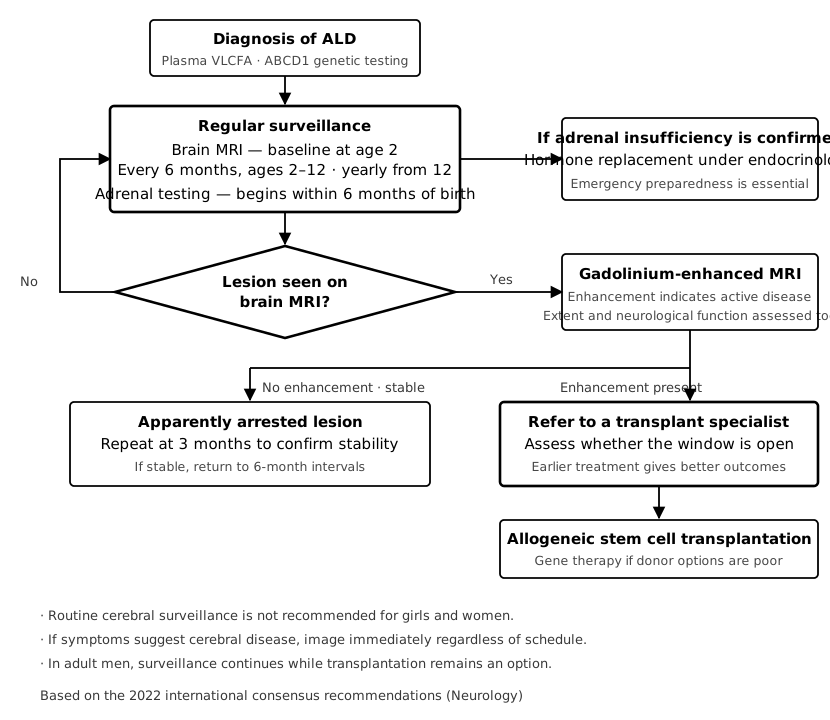
The surveillance schedule in the 2022 international consensus recommendations:
| Age | Brain MRI |
|---|---|
| 2 years | Baseline scan |
| 2–12 years | Every 6 months |
| From 12 years | Annually |
| Adulthood | Annually, without interruption — screening does not stop at adulthood |
The baseline is set at age 2 because myelination is incomplete before then and scans are difficult to interpret.
If symptoms suggestive of cerebral disease appear, imaging is performed immediately, regardless of the schedule.
Judging whether a lesion is active
When a lesion is seen, the next question is whether it is active now. Gadolinium enhancement is used for that judgement. Enhancement indicates ongoing inflammation and is a central factor in deciding when to treat.
The extent of the lesion and neurological function are assessed alongside it. Each is scored on an established scale, but those scores do not by themselves determine whether treatment goes ahead. Rate of progression, age and donor availability are weighed together.
Lesions sometimes stop on their own
Cerebral ALD does not invariably run to its end. A progressing lesion can arrest spontaneously. Why it does so is not known.
How often
The figure depends on which population is counted.
| Population counted | Proportion arresting |
|---|---|
| All males with ALD (178, Boston and Amsterdam) | 12.4% (22 patients) |
| Asymptomatic childhood cerebral ALD | about 20% |
| Conventional estimate in the earlier literature | 10–15% |
The figure usually quoted — around 20% — refers specifically to cerebral disease found in boys who have no symptoms yet.
What happens after arrest
Twenty-two patients with arrested disease, followed for a median of 2.4 years:
- 19 (86.4%) remained arrested at last follow-up
- 4 (18.2%) progressed again, then arrested a second time as the contrast enhancement resolved
- 3 (13.6%) converted to progressive cerebral ALD
Arrest is therefore not an ending. Lesions switch off, switch back on, and switch off again — a pattern the accompanying editorial likened to the relapsing–remitting course of multiple sclerosis.
Contrast enhancement is what separates them
The clearest division in the study:
Not one patient who never showed gadolinium enhancement converted to a progressive phenotype.
Conversely, the appearance of enhancement was strongly associated with progression. This is why the preceding section treats enhancement as it does.
Age
Arrested lesions were first detected at a median age of 23.3 years (range 8.0–67.6). They can begin in childhood, but detection in adulthood is more common, and half the patients had no symptoms when the lesion was found.
What follows from this
Arrested lesions are not transplanted. Transplantation carries substantial risk and does not alter the course in these patients — which is why the authors emphasise distinguishing arrested from progressive disease early and accurately.
Surveillance does not stop, however. Reactivation can occur at any age. Where a lesion appears arrested and non-enhancing, imaging is repeated after three months to confirm stability, and the interval then returns to the usual schedule.
Source: Mallack EJ et al. Clinical and radiographic course of arrested cerebral adrenoleukodystrophy. Neurology 2020;94(24) · DOI: 10.1212/WNL.0000000000009626
Treatment
Early haematopoietic stem cell transplantation is the only established treatment. It can halt progression but cannot reverse damage already done.
Leriglitazone has reached the point of a positive regulatory opinion in Europe, and gene therapy is a conditional option.
→ Set out in full on the Treatment page.
What else to check
Cerebral disease does not exclude the other problems.
Adrenal insufficiency is frequently present and may precede neurological signs. Testing begins within the first six months of life. → Adrenal Insufficiency
Transplantation does not affect myeloneuropathy. Even after cerebral disease is halted, AMN symptoms may appear in adulthood. → Adrenomyeloneuropathy
Head injury
Severe head trauma has been reported as a possible trigger for cerebral disease. The causal relationship is not established.
Even so, international recommendations advise counselling male patients about the possibility so that they can make their own decisions about how they live. Having had a head injury does not mean cerebral disease will follow, and there is nothing to reproach yourself for in what has already happened.
Further reading
ALD Connect sets out the standard of care in cerebral ALD in detail. → Cerebral ALD — Standard of Care (ALD Connect) → References and Links
Based on the 2022 international consensus recommendations (Neurology) and published research. Sources are indicated in the text.
Last reviewed: 10 August 2026
This page provides general medical information and does not replace care for an individual patient.